AI in a Beaker
Scinix builds intelligence out of chemistry. Our reaction networks sense, remember and learn, computing with molecules instead of transistors.
Live reaction-diffusion simulation running in your browser. Drag across it to add reagent.
What Scinix does
A living cell decides, adapts and remembers without a single wire. Every one of those decisions is a chemical reaction.
Scinix engineers that same capability on purpose. We design networks of coupled reactions whose concentrations carry information, whose nonlinear kinetics perform computation, and whose state can be trained to answer questions. The result is a computer you can pour.
How a beaker learns
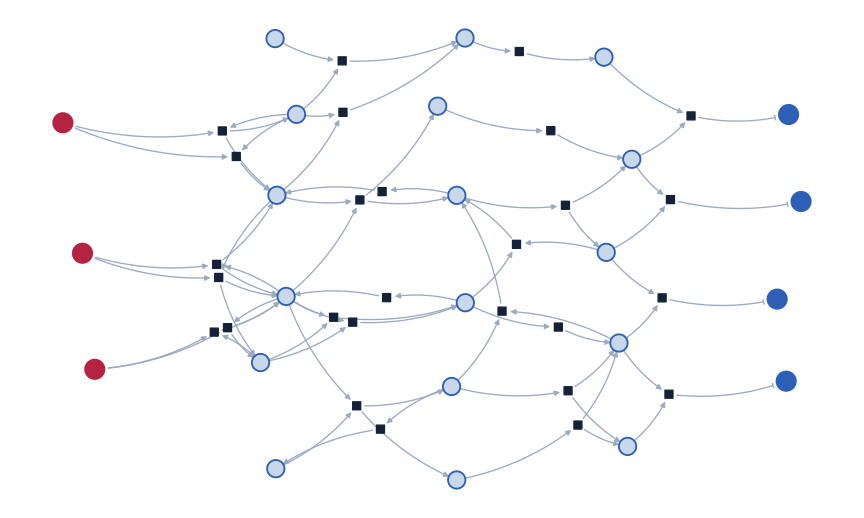
Chemical AI follows the reservoir-computing recipe: let a rich dynamical system do the hard nonlinear work, then train only a simple readout.
-
Encode
Inputs become chemistry: feed rates, reagent pulses, light or temperature that shift the reaction conditions over time.
-
React
Dozens of coupled reactions transform the signal. Autocatalysis supplies nonlinearity, slow intermediates supply memory, oscillators supply timing.
-
Read
We measure a handful of species, optically or electrochemically, as the network’s high-dimensional state.
-
Train
A lightweight readout is fitted to that state. The chemistry stays the same; only the interpretation is learned.
Chemistry that keeps time
The Belousov–Zhabotinsky reaction is the classic proof that a well-mixed solution can behave like a circuit. Bromate, an organic acid and a metal catalyst drive each other through a closed loop: the activator HBrO2 surges, the catalyst oxidizes, bromide floods back in and shuts the burst down.
The cycle repeats with clockwork regularity, roughly every 6.2 time units in the model at right. Oscillators like this give a chemical computer its clock, and their sharp switching gives it logic.
ε dx/dt = qy − xy + x(1 − x)
View data table
Two molecules, endless behavior
These four images come from the same pair of reaction-diffusion equations. Only the feed rate F and removal rate k change. Choosing those numbers well is what reaction engineering is for.




View data table
Memory and nonlinearity, from kinetics alone
Here a bank of 16 stirred reactors, each running a Brusselator reaction with its own time constant, receives one fluctuating input through its feed. The task requires remembering the input from 3 and 6 time units ago and multiplying them, something no single reaction does on its own.
Only a linear readout of the measured concentrations was trained. On data it had never seen, the chemistry explains 72% of the variance in the target.
- Variance explained (R2)
- 0.72
- Trained parameters
- 65
- Wires in the computing core
- 0
Built on proprietary kinetics software trusted by researchers worldwide
A chemical computer is only as good as the model behind it. Part of Scinix runs on proprietary software and custom chemical system reaction engineering developed in house, including Kintecus, a chemical kinetics and equilibrium simulator cited in close to 1,000 scientific publications.
Stiff reaction networks at scale
Large mechanisms integrated with robust stiff ODE solvers, the same machinery researchers use for combustion and atmospheric chemistry.
Fitted to real experiments
Rate constants and mechanisms are regressed against measured data, with bootstrap confidence intervals, so designs rest on validated chemistry rather than guesses.
Sensitivity and control
Normalized sensitivity analysis shows which reactions steer each output, telling us exactly where to tune a network for the behavior we want.
Custom reaction engineering
Reactor configuration, feed schedules, thermodynamic equilibrium and pressure effects are engineered together, taking a design from simulation to bench.
Where chemical intelligence fits
Sensing in wet environments
Computation that lives inside the sample: water lines, bioreactors and process streams where electronics struggle.
Smart materials
Gels and coatings that respond to patterns of stimuli, not just single triggers.
Molecular diagnostics
Reaction networks that weigh several biomarkers at once and report a decision as a color change.
Ultra-low-power edge logic
Chemistry that runs on its own reagents, with no battery or power supply in the loop.
Intelligence shouldn’t need a power plant
The human brain runs on about 15 watts, roughly the draw of a lightbulb. A typical modern data center consumes anywhere from 10 to over 100 megawatts. A 75-megawatt facility draws five million times more power than the brain it is trying to imitate.
Chemistry is how nature closes that gap. Scinix computes with reactions that run on their own reagents at room temperature, the same way biology does.
5,000,000× more power for a 75 MW data center than for one human brain
Have a problem chemistry could solve?
We partner with research groups and companies on custom reaction-network design, kinetic modeling and chemical computing prototypes.
For more information, email jianni10@gmail.com.
Email for more info